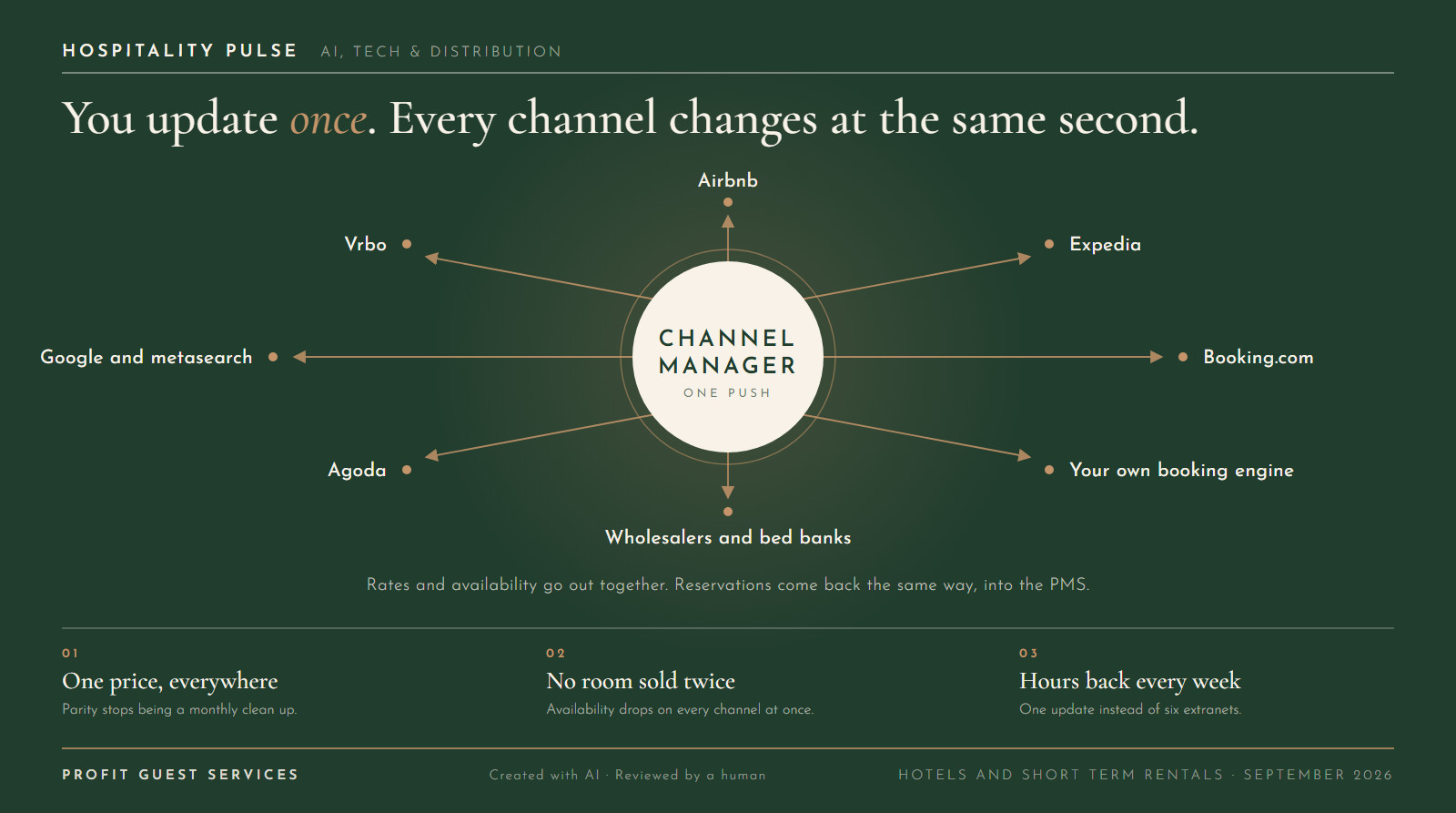
A channel manager is bought as plumbing and reviewed like plumbing: compared on price and channel count, installed once, and never opened again unless something breaks. That framing is what costs money. It is the place where your commercial strategy either survives contact with the channels or gets quietly flattened.
My position, after the audits I have done, is that the choice of tool matters less than the vendor comparisons suggest, and the configuration matters far more than anyone admits. A hotel on a mid-tier channel manager with a reviewed configuration makes more money than the same hotel on the market leader with the defaults still in place. The licence costs a few hundred a month. The configuration is worth several points of ADR (average daily rate) a year.
So this piece does both jobs: what to decide before you connect, the five settings I find bleeding ADR in almost every audit, and the tools I would shortlist in 2026 for hotels and for short-term rentals, with the criteria written out so you can disagree with them.
Before you connect: the map and the mapping
The most expensive mistakes are made before the first rate is loaded.
One master per type of information. Inventory belongs to the PMS (property management system), because the reservation that reaches the desk decides which room is sold. Rate strategy lives in one place: the PMS, a revenue management system pushing into the channel manager, or the channel manager itself. Never split across two of them plus the extranets. If part of the strategy lives in each, you are doing the work three times and none of the three copies is right. The same rule governs derivations. A rate derived on the OTA's side follows its parent there and cannot be driven from your channel manager, so a plan derived in two systems fights itself forever.
Latency is a number you ask for before signing. Some tools carry a delay of ten to twenty minutes. In that window a reservation lands in the PMS, availability drops to zero, and the channel manager still believes there are three rooms and keeps selling them. That is an overbooking manufactured without anyone touching a setting. Ask for the number, and ask how rejected updates are reported: a rate a channel refused has to be visible to a person.
Your own booking engine is a channel. It must receive the same rates, availability and restrictions at the same moment as the OTAs (online travel agencies). Google scores price accuracy by comparing what it shows with what the guest finds on your booking page. It is a tiered score rather than a single cutoff, and as it falls Google turns off most of your ads and free booking links, then all of them. Feeding the direct channel last is a decision to be penalised for it.
Mapping is the dictionary, and it needs test bookings behind it. What is not mapped does not exist for the connection: for an unmapped rate the updates are never sent and the reservation never comes back. Map rooms by physical inventory, not by marketing name. Keep the plans few. The channels allow far more than you need, and a hotel running more than a dozen usually has plans nobody can explain. Then test before go-live and after every structural change, one booking per channel and per plan, checking it lands with the right room, rate code, price, policy and payment method, and that the cancellation comes back. Set a minimum and a maximum rate guard so a typing error is rejected instead of published.
This is not optional housekeeping. HOTREC's European study (2024) found channel manager use rose from 39% of hotels in 2013 to 62% in 2023, while hotels managing rates by hand fell from 56% to 27%. The connection now carries the strategy for most of the market.
The five settings that lower ADR without any alarm
A channel manager's alarms fire when a channel rejects an update, when a mapping breaks, when a booking fails to land. None fires when the configuration is technically correct and commercially wrong. That second case is the expensive one: occupancy holds, the dashboards show conversion rising, and the ADR drifts down a few points a quarter with nobody able to name a cause.
1. The non-refundable rate as a permanent percentage. A flexible rate, and a non-refundable derived from it at a fixed 15% or 20%, every day of the year on every room type. The discount buys one thing: certainty on the books in exchange for a lower price. On a weather-dependent long weekend three months out, that is a fair trade. On a city-event date inside the booking window, most guests would have paid the flexible price, and you just paid 20% for a security you already had. Treat the discount as a lever with a calendar, not a constant. D-EDGE's distribution report (2024) found that in Europe in 2023, 42% of revenue booked through Booking.com was cancelled, against 18% on the direct channel, so the certainty is worth buying, but not everywhere and not always.
2. Categories derived from one base with fixed gaps. Standard double as the base, superior at base plus a fixed amount, suite at base plus another. Demand does not arrive with the same shape for every category: families and event guests push suites, business travel pushes standards. A fixed gap moves every category when the base moves, whether its own demand justifies it or not. The gap is also wrong at both ends of the year: a 60 supplement on a 90 room sends the guest to the standard in low season, and the same 60 on a 250 room is cheap in high season. Derive by season instead of by one rule, widen the supplements when demand is strong and narrow them when it is not, and review each category against its own pickup rather than against the base. Where a category has demand of its own, give it its own plan.
3. OTA promotions left on, stacking on the rate you sent. The channel manager sends a BAR (best available rate) of 100. In the extranet there is a Genius discount for members, a mobile rate, a country rate and a campaign nobody ended. Each was switched on for a good reason and each looks small on its own.
Here is the part most people have backwards. On Booking.com the mobile rate and the country rate sit at the same level and do not stack with each other. The one that stacks is Genius. So it is Genius plus mobile, or Genius plus country, never mobile plus country, and on top of that whatever campaign you are running. Take a BAR of 100: Genius takes 10% and leaves 90, the mobile rate takes 10% of that and leaves 81, a 20% campaign on top leaves 64.80. That is a 35.2% cut on a rate the channel manager believes is 100, and it is why percentages cannot be added: 10, 10 and 20 are not 40. The guest pays 64.80, the booking lands in the PMS at 64.80, commission comes off that, and every system involved reports success. Give each promotion a start date, an end date and a written reason, and calculate new discounts backwards from the ones already applied.
4. Restrictions of the wrong type, at the wrong level. A minimum stay "through" applies to any stay touching the date, so three nights through Saturday refuses a guest arriving Friday for two. A minimum stay "on arrival" lets that guest in. Not every channel supports both, so the rule you set may reach one OTA as you meant it and another as a blanket block. The date fills anyway, because it was strong, and the 100% at the end hides the two-night, high-rate requests that were turned away. One restriction per purpose, at the level where it applies, verified on the channel as a guest.
5. Net and static plans without a floor. A wholesaler receives BAR minus 20% to 30% as a static plan. That rate travels: resold to bed banks, from them to OTAs and affiliates, and it reappears on metasearch below your own website at whatever markup the last reseller kept. Derive every B2B rate from the live BAR so it moves when you move, put a markup floor in the contract, and mystery shop by changing one variable at a time. A public disparity does not prove who broke the rule. A controlled booking, reconciled from public price to voucher to PMS rate code, does.
How do you choose a channel manager for a hotel or a short-term rental?
A channel manager is the system that pushes your rates and availability to every channel and pulls the reservations back. Choose it on connection quality first and features second. Three checks decide it. First, the certification tier each OTA gives the provider: Airbnb names 19 Preferred+ software partners for 2026, and Booking.com runs Certified, Premier and Premier Plus tiers. A top tier means the integration is tested, not just marketed. Second, the synchronisation latency in minutes, asked for before signing, because a 15-minute delay manufactures overbookings on your best dates. Third, whether the tool holds your rate architecture: derivations that vary by season, restrictions at room-type level, and rate guards. The leaders for independent hotels in 2026 are SiteMinder, Cloudbeds, STAAH, eviivo and RateGain. For short-term rentals, Hostaway, Guesty, Lodgify, OwnerRez and Rentals United. Price matters least: the money is lost in the configuration, not in the licence.
The shortlist for hotels
The criteria, so you can argue with them: the ranking voted by hoteliers at Hotel Tech Report in 2026, built from 8,217 verified reviewers across 149 products, and the connectivity tier each provider holds with the major OTAs. No vendor pays to be on this list and there are no affiliate links in this article.
Those tiers do not all carry the same weight, and you should know which is which. The Airbnb Preferred+ tiers come from the list Airbnb publishes itself. Booking.com does not publish its 2026 tier list openly, so the Premier and Premier Plus tiers named below come from each provider's own announcement as reported by the trade press. Treat the first as a fact and the second as a claim with a witness.
One transparency note about the ranking. Hotel Tech Report's global top five for 2026 is SiteMinder, Cloudbeds, Yanolja Cloud Solution, RateGain and Profitroom. Two of those are Asia Pacific specialists, so for a reader in Europe, the Americas or the Caribbean I have put STAAH and eviivo in their place and said why below. If you operate in Asia Pacific, put Yanolja and Profitroom back.
| Tool | Why it is here | Who it is for, and who it is not for |
|---|---|---|
| SiteMinder | Ranked first in the channel manager category at Hotel Tech Report, 2026 | For the independent hotel that wants the widest tested channel list. Not for a five-room guest house: you pay for reach you will not use |
| Cloudbeds | Awarded at Hotel Tech Report every year from 2021 to 2026, and an Airbnb Preferred partner | For small and mid-sized properties, strongest in North America. Not for a hotel that wants a channel manager alone and is keeping a PMS it likes |
| STAAH | Booking.com Premier Plus connectivity partner for the fifth year running in 2026 | For properties with most of their volume on Booking.com. Not for a hotel whose problem is wholesale and B2B distribution |
| eviivo | Airbnb Preferred partner, and the one here built for mixed inventory | For hotels that also run apartments or villas. Not for a pure city hotel, where the flexibility costs simplicity |
| RateGain | Fourth in the Hotel Tech Report channel manager ranking, 2026, with its RezGain product, and the only one here built around rate shopping and parity | For mid-sized hotels and groups that price against a comp set. Not for an owner-operated property: it is more machine than that job needs |
If you are that owner-operated property in Spain or southern Europe, Amenitiz is the better fit at that size.
The shortlist for short-term rentals
Same method, different sources. Airbnb publishes its own list of software partners and names 19 Preferred+ providers for 2026, which is the closest thing this market has to an independent certification.
| Tool | Why it is here | Who it is for, and who it is not for |
|---|---|---|
| Hostaway | Airbnb Preferred+ and Booking.com Premier Plus, the top tier at both | For portfolios of roughly 10 units and up. Not for a single listing: you will pay for automation you do not need yet |
| Guesty | Airbnb Preferred+, the widest channel reach in the market, with a lighter product, Guesty Lite, for smaller hosts | For professional managers, and small hosts on the Lite product. Not for anyone who wants a light monthly cost |
| Lodgify | Airbnb Preferred+ and a Booking.com Premier partner, with a website builder for direct bookings | For hosts with one to ten units who want a direct channel. Not for a manager needing broad OTA reach: the direct API list is short |
| OwnerRez | Airbnb Preferred+, and the most configurable of the five | For owners who want control and will configure it themselves. Not for someone who wants it working by Friday without reading anything |
| Rentals United | Airbnb Preferred+ and a pure distribution layer rather than an all-in-one, reaching the long tail of OTAs | For managers of 20 units and up who already have a PMS. Not for a host with no PMS: it distributes, it does not run your operation |
One disclosure the vendor pages do not lead with: Guesty acquired Rentals United in May 2024, and also owns YieldPlanet. If you are shortlisting both to compare, you are comparing two products from the same company.
Worth a look if none of the five fits: Hospitable for an Airbnb-first operation, Uplisting, Beds24, Smoobu in Europe and iGMS.
The audit that fits in one afternoon
- Take a phone, log in to the OTA as a member, and search one peak date and one weak date for one night and for two. Write the prices next to what the channel manager says it sent.
- Export the last 90 days of bookings by rate plan and channel and compute net ADR per plan, after discounts and commission.
- List every promotion active in every extranet with its end date and its reason. Anything without both gets closed.
- For each restriction, note the type and the level, then confirm it on the channel.
- List every net or static plan, who it is contracted to, and whether it has a markup floor and a live derivation.
Most of this is administrative work a revenue manager does not have time for, which is why it does not get done. It is also exactly the kind of work that can be systematised: the checks are the same every month and the data already sits in the PMS and the extranets. The hours that go into it come back as decisions, and the decisions are where the ADR is.
If you would rather not work out which of the five is running in your property, tell us two things, the channel manager you use and the OTA you sell most on, and we will tell you which one you have and what it is costing. It takes a minute to ask and you get a written answer: profitguestservices.com/audit